













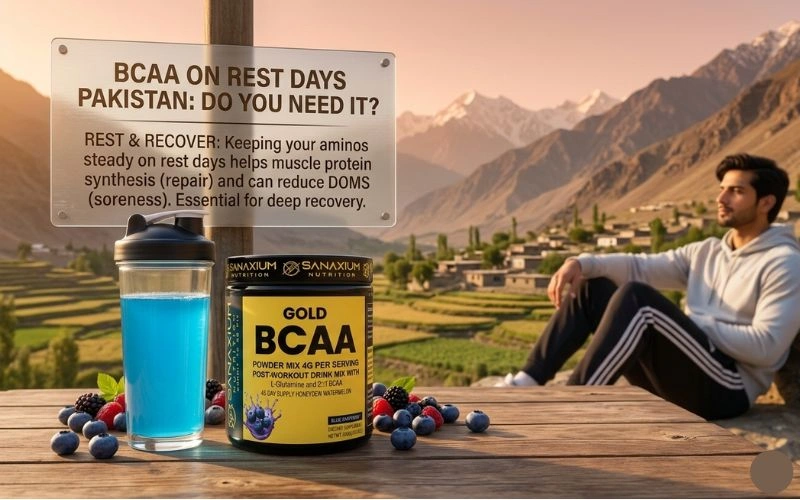
No, you do not need to take BCAAs on rest days, but doing so is not harmful and can be genuinely beneficial if your protein intake from food is low, if you are in a caloric deficit, or if you are recovering from a particularly demanding training week. Whether rest day BCAA use makes sense for you depends on your diet, your training volume, and how quickly you recover between sessions.
Table of Contents
What BCAAs Actually Do in the Body
To answer this question properly, you need to understand how BCAAs work and what purpose they serve beyond the training session itself.
Branched-chain amino acids, leucine, isoleucine, and valine, are essential amino acids your body cannot produce on its own. Leucine in particular is the primary trigger for muscle protein synthesis, the process through which your body repairs and builds muscle tissue. This process does not stop when you leave the gym. It continues for 24 to 48 hours after a training session, which means the period when you are resting is also a period when your body is actively repairing the muscle fibres that were broken down during your workout.
If amino acid availability is limited during that repair window, the rate of muscle protein synthesis slows. This is where rest day BCAA use becomes a legitimate consideration rather than just supplement marketing.
The Case for Taking BCAAs on Rest Days
Muscle repair happens predominantly on rest days, not during training. When you lift weights or train hard, you create microscopic damage in muscle fibres. The adaptation, the actual growth and strengthening, occurs during the recovery period that follows. For that repair process to run efficiently, your body needs an adequate supply of amino acids throughout the day, not just in the hour after your workout.
The strongest argument for rest day BCAA use is reducing muscle soreness and accelerating the repair of that micro-damage. Studies have shown that leucine-rich BCAA supplementation on rest days can reduce delayed onset muscle soreness, shorten recovery time between sessions, and preserve lean muscle mass during periods of caloric restriction.
For Pakistani gym goers following a typical three to five day training split, rest days are not passive. They are when the body does its most important work. Supplying BCAAs during that window supports the process directly.
The Case Against Taking BCAAs on Rest Days
The honest counter-argument is equally important. If your diet already contains sufficient high-quality protein, your body has everything it needs to synthesise muscle protein without any additional supplementation. Chicken, eggs, fish, dairy, and legumes all provide the full spectrum of amino acids including leucine, isoleucine, and valine in meaningful quantities.
Whole food protein sources also come with additional nutrients, including vitamins, minerals, and dietary fibre, that isolated amino acid supplements do not provide. If your daily protein intake from food consistently hits around 1.6 to 2.2g per kilogram of bodyweight, which is the evidence-backed range for muscle building and maintenance, rest day BCAA use adds very little marginal benefit.
The decision essentially comes down to one question: is your dietary protein sufficient on rest days? If yes, skip it and spend the money elsewhere. If no, a BCAA supplement fills a real gap.

When Rest Day BCAA Use Makes Sense
There are specific situations where taking BCAAs on rest days is a reasonable and practical choice. Consider it if any of the following apply to you.
You are in a caloric deficit for fat loss. When total food intake drops, protein intake often drops with it. BCAA supplementation on rest days helps maintain muscle protein synthesis signals even when calories are lower, protecting lean mass during a cut. This is one of the most well-supported use cases for rest day amino acid intake.
You follow an intermittent fasting protocol or skip meals regularly. If you fast for extended periods during the day, your body’s amino acid availability drops between feeding windows. Taking BCAAs while fasting between meals on rest days keeps muscle protein synthesis supported without significantly affecting your caloric intake. The related question of whether amino acids break a fast is worth understanding if strict fasting is part of your routine, as the answer depends on the purpose of your fast.
You are a high-volume trainer who works out five or more days per week. With only one or two rest days between sessions, your muscles are in a near-constant state of repair and rebuilding. Consistent amino acid availability across all days, including rest days, supports that ongoing process more effectively than spiking amino acid intake only on training days.
Your diet is predominantly plant-based or lacks reliable complete protein sources. Pakistani dietary patterns vary significantly, and not everyone consumes sufficient animal protein daily. If your protein sources are primarily lentils, legumes, or vegetables without adequate dairy or eggs, daily amino acid supplementation on rest days bridges the gap in a practical and cost-effective way.
How BCAAs Compare to Whole Protein on Rest Days
One question worth addressing directly is whether a BCAA supplement or a full protein source is the better choice on rest days. The answer is that whole protein is always preferable if accessible, but BCAAs have practical advantages in specific contexts.
BCAAs vs EAAs for recovery is a relevant comparison here too. EAAs contain all nine essential amino acids and provide a more complete muscle protein synthesis stimulus than BCAAs alone. If you are going to supplement on rest days specifically for recovery purposes, EAAs are arguably the more complete option. BCAAs remain practical, however, because they are lighter on the stomach, easy to sip throughout the day, and appropriate for people who are not trying to add calories.
Casein protein is another rest day option worth considering. Unlike whey, which digests rapidly, casein releases amino acids slowly over six to eight hours, making it particularly well-suited for overnight recovery. Many gym goers who use whey on training days switch to casein on rest days or before bed to maintain a sustained amino acid supply during the longest fasting window of the day.
How to Take BCAAs on Rest Days
If you decide rest day BCAA use makes sense for your situation, the timing and approach differ from your training day routine. On training days, most people use BCAAs as an intra-workout supplement, sipping them during the session. On rest days, the goal is different: you want to maintain amino acid availability across the day rather than spike it around a workout that is not happening.
The most practical approach for using amino acids for faster recovery on rest days is to take one serving between two of your largest meals, particularly during gaps where you go three or more hours without a protein-containing meal. This keeps muscle protein synthesis ticking over without requiring you to restructure your eating habits significantly.
Mix one serving in 300 to 400ml of cold water and sip it steadily over 15 to 20 minutes rather than drinking it in one go. There is no meaningful advantage to taking it at a specific time on rest days the way there is for timing around a workout. Consistency across the week matters more than precision on any individual day.

What the Research Actually Says
The research on BCAA supplementation broadly supports their effectiveness for recovery and muscle preservation, particularly in the context of resistance training. However, most studies showing significant benefits are conducted on subjects in a caloric deficit or with sub-optimal protein intake. When dietary protein is adequate and total food intake is sufficient, the incremental benefit of adding BCAAs on rest days is modest and difficult to detect in controlled studies.
This does not mean rest day BCAA use is ineffective. It means the benefit scales with the gap in your diet. The larger the gap, the more meaningful the supplement becomes. For gym goers in Pakistan who train hard but do not always hit their protein targets through food alone, the gap is often larger than they realise. The BCAA recovery guide provides a broader context for how BCAA use fits into a training and recovery plan specific to the Pakistani gym environment.
Which BCAA Products to Consider
If you decide to use BCAAs on rest days, the product choice matters less than consistency of use. That said, two products stand out as reliable, widely available, and verified in the Pakistani market.
Xtend BCAA by Scivation delivers 7g of BCAAs per serving alongside glutamine and electrolytes, making it a strong choice for rest day use because of the additional recovery and hydration support. Rule 1 BCAA is the cleaner, more minimal option with 5g of BCAAs per serving and no added ingredients, which suits gym goers who prefer to keep their rest day supplementation simple and controlled.
Both are available through verified importers. If halal certification is a consideration for you, checking halal BCAA options and confirming the current batch certification with the importer before purchasing is the right approach. You can browse the full range of verified BCAA supplements in Pakistan to find what fits your budget and goals.
Who Should and Should Not Bother
Rest day BCAA use is worth the investment for the following people. Those in a caloric deficit trying to preserve muscle during a cut. High-volume trainers with only one rest day per week. Anyone whose diet is inconsistent or protein-poor on non-training days. People who fast between meals and want to support recovery without breaking their eating pattern with a full meal. Those building their beginner supplement routine who are not yet consistent with dietary protein.
It is not worth the additional cost for people who consistently hit their protein targets through food, eat three or more complete protein-containing meals daily, train only two to three days per week with ample recovery time between sessions, or are on a tight supplement budget where the money would be better spent on whey protein or creatine.
Frequently Asked Questions
Will BCAAs make me gain weight on rest days?
No. A standard serving of BCAAs contains around 20 to 30 calories depending on the product. This is nutritionally negligible and will not contribute to weight gain. If you are tracking calories carefully, account for it, but do not let it be a reason to avoid rest day use if it serves a recovery purpose.
Can I take my full workout dose of BCAAs on rest days?
You can, but there is no particular advantage to matching your training day dose on rest days. A single standard serving between meals is sufficient for rest day recovery purposes. Using a full double serving adds cost without meaningfully adding benefit.
Is it better to take BCAAs on rest days or just eat more protein?
Eating more whole food protein is always preferable to supplementing if both options are available to you. Whole foods provide a broader nutritional profile. BCAAs are the practical choice when adding a full protein-containing meal is inconvenient, impractical, or does not fit your eating pattern on a particular day.
Do BCAAs help with sleep and overnight recovery?
BCAAs alone are not particularly effective for overnight recovery because they digest rapidly. If overnight recovery is a specific goal, casein protein taken before bed is more effective due to its slow digestion rate and sustained amino acid release. BCAAs are better suited to filling gaps between daytime meals rather than overnight supplementation.
How long should I take BCAAs before seeing recovery benefits?
Consistent use over two to four weeks is typically where gym goers begin noticing reduced soreness and faster readiness between sessions. Like most supplements, BCAAs work cumulatively and consistently rather than providing an acute benefit from a single dose.