













Walking into a supplement store or browsing online can feel genuinely overwhelming. There are hundreds of products, each promising faster gains, better recovery, and superior performance. But here is the truth that most brands will not tell you: the best supplement stack for muscle gain is not the most expensive one or the most complex one. It is the one that matches your training level, your diet, and your actual goals. This guide breaks it all down, from what a complete beginner needs on day one, to what a seasoned lifter should be stacking for serious results.
Table of Contents
Why Your Training Level Changes Everything
Not every supplement works the same way for every person, and the single biggest variable is training experience. A beginner’s body responds to almost any stimulus, so even a basic routine with minimal supplementation produces visible results within weeks. A pro, however, has already captured most of the low-hanging fruit. Their body is adapted, their recovery demands are higher, and their nutritional requirements are more specific.
This is not just theory. It is why a beginner who adds whey protein and creatine sees dramatic changes, while an experienced lifter doing the same sees incremental ones. Understanding this distinction prevents you from spending money on advanced supplements before your foundation is solid, and it prevents experienced lifters from plateauing because they are still running a beginner stack.
The Foundation Always Comes First
Before getting into specific products for each level, it helps to establish what has to be in place regardless of experience. Before any supplement does its job, three things need to be in place: consistent training, adequate calories, and sufficient sleep. Supplements work on top of these foundations. They do not replace them.
The Beginner Supplement Stack for Muscle Gain
With the foundation covered, here is what actually belongs in a beginner’s stack. The beginner phase of training, roughly the first six to eighteen months, is when your body is most responsive to both training and nutrition. Muscle protein synthesis is elevated, neurological adaptations are happening rapidly, and your recovery capacity, while still developing, is more forgiving than it will be later.
This means a beginner does not need a complex or expensive stack. What they need is consistency with a small number of high-impact supplements that directly support the training process.
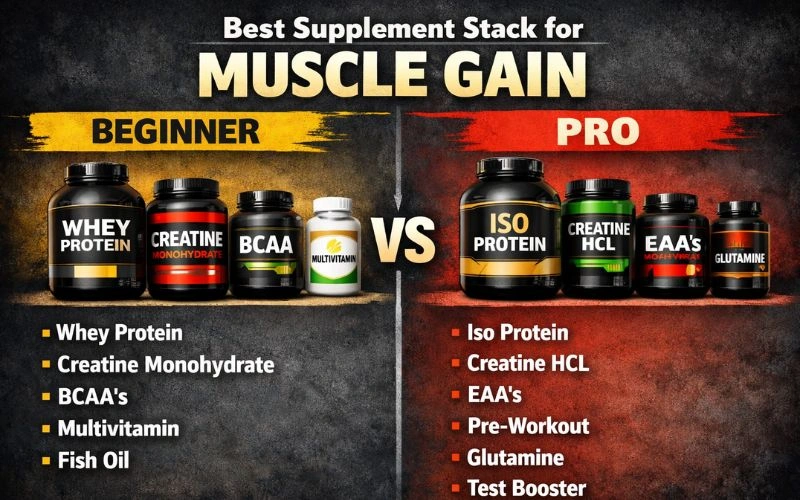
- Whey Protein: The most important supplement for any beginner. It closes the gap between dietary protein and your daily requirement, which for muscle gain sits at approximately 1.6 to 2.2 grams per kilogram of body weight. This overview of what protein supplements actually do in the body explains the different types and how they work.
- Creatine Monohydrate: The most researched performance supplement in existence. A daily dose of 3 to 5 grams increases strength output, improves high-intensity performance, and accelerates visible muscle gain. This breakdown of what the research says about creatine’s benefits covers what the science actually shows.
- Multivitamin: Beginners are often nutritionally inconsistent. A quality multivitamin fills micronutrient gaps that would otherwise slow recovery and energy levels. This guide to finding a multivitamin that fits your budget helps you find a solid option without overspending.
What Beginners Should Avoid
Just as important as what to take is knowing what to skip early on. The supplement industry is built on making beginners feel like they need everything at once. Pre-workouts, fat burners, testosterone boosters, and advanced amino acid formulas are all heavily marketed toward new gym-goers. For most beginners, these add cost without adding proportional benefit.
This practical starting point for gym beginners takes a clear-eyed look at what actually moves the needle early on and what can wait. The answer is almost always: start simple, get consistent, then layer in more specific support.
The One Supplement That Belongs in Both Stacks
Creatine is worth its own section because it is genuinely one of the few supplements that delivers measurable results at every level of training experience. It works by increasing phosphocreatine stores in your muscles, which fuels the ATP system during explosive, high-intensity efforts such as lifting, sprinting, and any short-duration power output.
For beginners, creatine increases strength so quickly that it often transforms the training experience entirely. For pros, it sustains output during longer training blocks and supports recovery between sessions.
The timing and dosing question comes up constantly. This look at whether pre-workout or post-workout creatine timing matters more addresses this directly. The short answer: consistency matters more than timing. Take it daily, with water, and the results accumulate regardless of when in the day you take it.
Creatine Loading vs Maintenance
Within that daily consistency, there is still a choice to make about how you start. Some experienced lifters choose a loading phase, taking 20 grams per day for five to seven days, to saturate muscle stores faster before dropping to a 3 to 5 gram maintenance dose. Others skip loading entirely and go straight to maintenance, reaching saturation within three to four weeks.
The Intermediate Lifter: When to Add More
After six to twelve months of consistent training, your body has captured most of the beginner adaptations. Progress slows, recovery becomes more demanding, and the gap between your current performance and your potential starts to require more targeted support.
This is the stage where the stack expands, not dramatically, but strategically. The foundation of whey protein and creatine stays. What gets added is support for recovery, performance, and the areas where intermediate lifters most commonly stall.
- BCAA or EAA supplement: Branched-chain amino acids and essential amino acids support muscle protein synthesis and reduce muscle breakdown, particularly useful during cutting phases or training twice a day. This comparison of BCAAs and EAAs for recovery helps you decide which fits your training style.
- Omega-3: At higher training volumes, inflammation management becomes genuinely important. Omega-3 fatty acids reduce exercise-induced inflammation, support joint health, and improve recovery quality. This overview of omega-3’s combined heart and brain benefits covers the full picture.
- Pre-workout: Once training intensity has been consistently high for several months, a quality pre-workout can provide the focus and energy to push through plateaus, a distinction covered further in this comparison of pre-workout versus post-workout supplementation.

The Pro Supplement Stack for Advanced Muscle Gain
Advanced lifters, typically those with two or more years of serious, consistent training, operate in a completely different environment. Recovery is the limiting factor more often than training stimulus. The margins between good sessions and great sessions are nutritional, hormonal, and biochemical rather than mechanical.
The pro stack is not about adding random supplements. It is about precision. Every addition should have a clear role, a measurable impact, and a justification beyond marketing.
A well-designed pro stack typically looks like this.
- Whey Protein Isolate: At advanced levels, the quality of protein matters more. Isolate is faster digesting, higher in protein per gram, and lower in lactose, which is critical for athletes eating large volumes of food. This comparison of how isolate and concentrate differ explains the practical difference.
- Creatine Monohydrate (continued): Still essential. This review of creatine’s long-term safety profile confirms it holds up for those who have been using it for years.
- Casein Protein: Slow-digesting protein taken before sleep to sustain muscle protein synthesis overnight. This guide to how casein supports overnight muscle recovery explains exactly how and when to use it.
- Glutamine: Supports gut health, immune function, and recovery at high training volumes. This look at glutamine’s role in gut and immune health details why this matters more at advanced stages.
- ZMA or Zinc and Magnesium complex: Supports testosterone levels and sleep quality, both of which degrade under heavy training loads without proper micronutrient support.
Pre-Workout at the Pro Level
Even a proven supplement like pre-workout needs to be managed differently once you have years of consistent use behind you. At advanced stages, pre-workout selection becomes more nuanced. Tolerance builds quickly, and the difference between a productive session and an over-stimulated crash is real. This guide to why cycling off pre-workout periodically helps is essential reading for anyone who has been using pre-workouts consistently for more than a few months.
Stacking Creatine With Other Supplements
One of the most common questions at every level is whether creatine can be combined with other supplements and whether those combinations enhance results. The short answer is yes, and certain pairings are particularly effective.
Creatine combined with whey protein is the most fundamental and well-supported stack. This look at the synergy between creatine and whey protein covers how these two supplements work together in training contexts. Separately, this broader guide to stacking creatine with other supplements covers what works together and what does not.
Creatine mixed directly into a protein shake is both practical and effective. This walkthrough of mixing creatine directly into a protein shake covers the how and why in one place.
Budget Considerations in Pakistan
Supplement costs in Pakistan vary significantly depending on whether you are buying imported brands, locally produced options, or something in between. The good news is that the most effective supplements, whey protein and creatine, are available at every price point.
This breakdown of how imported and local supplements compare in Pakistan gives a clear picture of what imported brands actually offer over local alternatives and whether the price difference is justified. For most beginners, local or mid-tier options deliver full value. For advanced lifters who depend heavily on product quality and specific amino acid profiles, imported options may be worth the investment.

The Stack Is Only as Strong as the Diet Behind It
This point cannot be made strongly enough. No supplement stack, whether beginner or pro, produces results without a diet that supports muscle growth. Protein targets must be hit through food first and supplemented second. Caloric surplus is required for muscle gain, and that surplus must come from quality sources, not just any excess calories.
This guide to calibrating your daily whey protein intake helps you check supplement use against total dietary protein so you are not doubling up unnecessarily. And this look at how antioxidants help manage exercise-induced oxidative stress is relevant for anyone training hard, because oxidative stress from intense exercise accumulates quickly and slows recovery when not managed through diet and targeted supplementation.
Frequently Asked Questions
To close out, here are quick answers to the questions lifters at every level ask most often about building a supplement stack.
What is the single most important supplement for a beginner?
Whey protein, since it closes the gap between what most beginners actually eat and their daily protein target. Creatine monohydrate is a close second given how consistently it improves strength and training output.
Do advanced lifters really need a bigger stack than beginners?
Not necessarily bigger, but more targeted. Advanced lifters tend to add recovery-focused supplements like casein, glutamine, and omega-3, since their limiting factor is usually recovery rather than raw training stimulus.
Is pre-workout necessary for building muscle?
No. Pre-workout is a performance tool, not a muscle-building requirement. It becomes more useful once training intensity is consistently high and a beginner has already built a solid foundation with protein and creatine.
Can beginners take the same supplements as pros, just in smaller amounts?
Not really. It is less about quantity and more about which supplements actually matter at each stage. Beginners see the most benefit from a small, simple stack, while advanced lifters need more specific support because their easy gains are already behind them.
How much should a beginner budget for a starter stack in Pakistan?
A solid beginner stack of whey protein, creatine, and a multivitamin can be built affordably using local or mid-tier brands, without needing to spend on premium imported products right away.