















Table of Contents
How Creatine Works in Your Body
Before comparing the two strategies, it helps to understand why creatine works in the first place and what actually happens inside your muscles once you start taking it. Creatine plays a direct role in producing quick energy during high intensity effort by replenishing ATP levels in muscle tissue.
The Role of Creatine in Muscle Energy and Strength
Creatine helps your muscles regenerate ATP, the body’s primary energy currency, especially during short bursts of intense activity like weightlifting or sprinting. Higher creatine levels in muscle tissue translate directly into stronger, more explosive output during resistance training. To go deeper on this mechanism, see how creatine fuels muscle energy production.

What Happens Once You Start Taking Creatine
Once ingested, creatine gets stored in your muscles, but it takes time to reach full saturation. This is exactly why some people follow a loading phase, since it speeds up how fast that saturation point is reached. Both loading and maintenance arrive at the same destination, just through different timelines and daily dose sizes.
Creatine Monohydrate as the Standard Choice
While newer forms like creatine HCL exist on the market, creatine monohydrate remains the most researched, most affordable, and most consistently effective form available. For a closer look at how it stacks up against alternatives, see this comparison of creatine monohydrate against creatine HCL.
What Is the Creatine Loading Phase
The loading phase involves taking a higher dose of creatine for a short period to saturate your muscles as quickly as possible. This method appeals to athletes who want performance benefits without waiting weeks to feel them.
The Science Behind the Loading Method
Loading means taking a high dose of creatine for a short window, usually 5 to 7 days, to quickly saturate muscle stores. The standard loading dose sits at 20 grams a day, split into four servings of 5 grams each. For more on the underlying research, see this breakdown of how creatine builds strength through muscle saturation, which is consistently supported across studies on fast adaptation protocols.
The table below breaks down exactly how the dosing schedule shifts once the loading window ends.
- Days 1 to 5: 20g per day divided into 4 doses of 5g each
- After loading: 3 to 5g per day for ongoing maintenance
Fast Results but Not Mandatory
Loading can produce noticeable performance benefits within a week, but it is not a required step for anyone. Some people prefer to start directly with maintenance dosing to sidestep the bloating or water retention that a higher loading dose can bring. Since tolerance varies from person to person, reviewing common creatine side effects and how to manage them is worth doing before committing to a loading protocol.
What Is the Creatine Maintenance Phase
The maintenance phase involves taking a steady daily dose, usually 3 to 5 grams, to keep muscle creatine levels saturated over time. This approach is gentler and more gradual, which is why it is favored by beginners and long-term users alike.
How Maintenance Sustains Muscle Saturation
Maintenance dosing means taking 3 to 5 grams daily starting from day one. Your muscles still reach full saturation, just over 3 to 4 weeks instead of 5 days. For the longer term picture, evidence on creatine safety over extended periods of use confirms that this sustained low dose approach is both effective and well tolerated.
Typical Dosage and Duration
- 3 to 5g daily depending on body size and activity level
- Can be continued for several months without cycling off
Can You Skip the Loading Phase Entirely
Yes, research confirms loading is not required to reach the end result of saturated muscles, it simply takes longer with maintenance only dosing. If you are weighing whether daily creatine use holds up over the long term, current evidence gives a clear yes for healthy individuals.
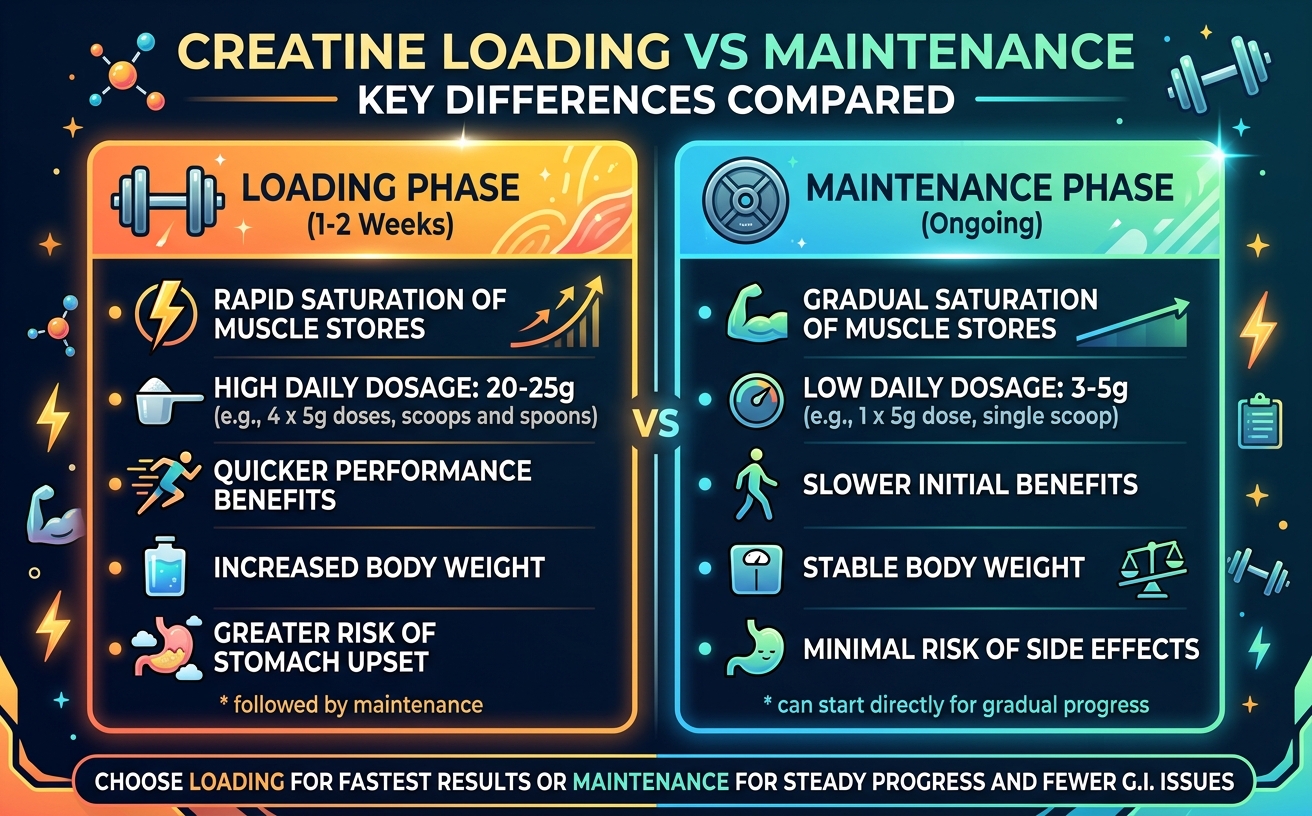
Creatine Loading vs Maintenance Key Differences Compared
Seeing the two approaches side by side makes it easier to decide which one fits your timeline, goals, and budget. The table below summarizes the most important distinctions.
| Aspect | Loading Phase | Maintenance Phase |
|---|---|---|
| Time to Effect | 5 to 7 days | 3 to 4 weeks |
| Dosage | 20g per day, then 3 to 5g per day | 3 to 5g per day from the start |
| Water Retention | Higher risk | Minimal |
| Cost | Uses more creatine upfront | More cost effective |
| Suitability | Athletes needing fast results | Beginners and long-term users |
Who Should Consider Loading and Who Should Not
Not every athlete shares the same goals or timeline, so the right approach depends heavily on what you are training toward. Here is a practical breakdown of which method suits which type of user.
Ideal Users for Loading Protocols
- Bodybuilders in a bulking phase who want rapid strength gains
- Athletes preparing for a competition with a tight timeframe
- Fitness models working toward a defined date for peak conditioning
If you fall into this group, pairing a loading protocol with a well structured stack can amplify the results. Explore how combining creatine with whey protein drives explosive strength for a deeper look at stacking these two supplements together.
When Maintenance Dosing Makes More Sense
- Beginners or anyone trying creatine for the first time
- People concerned about water retention or bloating
- Anyone who prefers a slower, gentler approach to saturation
For new gym-goers still building out their supplement routine, our overview of essential supplements every gym beginner needs is a solid starting point before layering in creatine.
Special Considerations for Teens, Women, and Older Adults
For these groups, maintenance dosing tends to be safer and easier to manage day to day. Women in particular have good reason to lean toward this approach, and the evidence supporting creatine safety and effectiveness for women is well established. Always consult a healthcare provider if you have existing health concerns before starting any protocol.
Is Creatine Loading Safe
Despite years of gym culture myths, current scientific research paints a consistently reassuring picture on creatine safety, even at loading doses. Research confirms creatine loading is safe for healthy individuals when taken at recommended dosages alongside proper hydration.
Common Myths About Kidney Damage and Hair Loss
Modern studies push back firmly on the older rumors. There is no established link to kidney damage in healthy individuals, a topic examined thoroughly in research on how creatine actually affects kidney health. There is also no direct evidence connecting creatine use to hair loss. If hair health is a separate concern of yours, targeted supplement options for hair thinning address that issue on its own.
What Recent Research Says About Long-Term Use
A recent meta-analysis concluded that creatine is safe for long-term use, including during the loading phase. For a thorough look at what the peer-reviewed literature says about extended supplementation, the evidence supporting sustained creatine use in healthy adults stays consistently reassuring across studies.
How to Avoid Side Effects with Hydration and Diet
A few straightforward habits can prevent most of the minor side effects some users report during a loading phase.
- Drink at least 3 liters of water a day to support creatine uptake
- Avoid stacking high caffeine pre-workout formulas during the loading window
- Take creatine alongside carbohydrates to improve muscle absorption
Tips for Getting the Most Out of Creatine
Getting real results from creatine takes more than just picking a dose. Timing, stacking, and tracking your progress all play a role in how effectively the supplement works for you.
Timing Creatine Around Your Workout
Both pre and post workout timing can work, but taking creatine after training alongside protein and carbohydrates may offer better uptake thanks to the insulin response that helps drive nutrients into muscle cells. For a detailed breakdown of this debate, see the research on optimal creatine timing around your training window. You can also explore the broader question of the best time of day to take creatine monohydrate.
Stacking with Carbohydrates for Better Absorption
Pairing creatine with fruit juice or a carb-heavy meal helps shuttle it into muscle tissue faster, which is particularly useful during a loading phase when you are trying to saturate muscle stores as quickly as possible. Anyone interested in building an effective creatine supplement stack will find that carb timing is one of the most underrated levers available.
Tracking Progress Through Both Phases
- Monitor weight, strength, and energy levels week by week
- Take progress photos to track water based muscle fullness and size changes
- Log workouts to separate genuine performance gains from placebo effect
If you train in particularly hot conditions, staying on top of fluid intake matters even more, and understanding how dehydration affects strength training performance is worth reading alongside any creatine protocol.
Pick the Creatine Plan That Matches Your Goals
There is no single right answer to creatine loading versus maintenance. It comes down to your timeline, your goals, and how your body tends to respond to a higher starting dose.
If faster results matter most to you, loading makes sense. If you are in it for the long haul, maintenance will get you to the same place, just more gradually. Either way, consistency is the factor that matters most over time. Whichever protocol you choose, using a quality product matters just as much as the dosing schedule itself, and picking a reliable form covered in this guide to choosing a trustworthy creatine supplement is a good place to start. Browse the full range of creatine monohydrate available in Pakistan at Nutritional World to find a product that matches your budget and goals.
Frequently Asked Questions
Do I need a loading phase to see results with creatine
No. You can start with 3 to 5 grams per day and still reach full muscle saturation in about 3 to 4 weeks without ever doing a loading phase.
What happens if I skip the loading phase
You will still get the same results. It just takes longer, roughly 3 to 4 weeks instead of 5 to 7 days, for creatine to fully saturate your muscles.
Is creatine loading bad for your kidneys
Not in healthy individuals. Current research shows no established link between creatine loading and kidney damage when it is taken at recommended doses with adequate hydration.
How long should a loading phase last
Typically 5 to 7 days at 20 grams per day, split into four 5 gram servings, followed by a maintenance dose of 3 to 5 grams per day.
Can women use creatine loading and maintenance safely
Yes. Creatine is safe and effective for women, particularly for building strength and lean muscle mass. Maintenance dosing is generally the more comfortable starting point for women new to creatine.
What is the best creatine form for loading
Creatine monohydrate remains the most researched and cost effective form for both loading and maintenance protocols, and it consistently performs as well as or better than newer forms in scientific literature.
Does hot weather affect how I should take creatine
Yes. Hydration becomes even more important in hot conditions, so aim for at least 3 liters of water a day and consider splitting your dose across the day to reduce any digestive discomfort.