













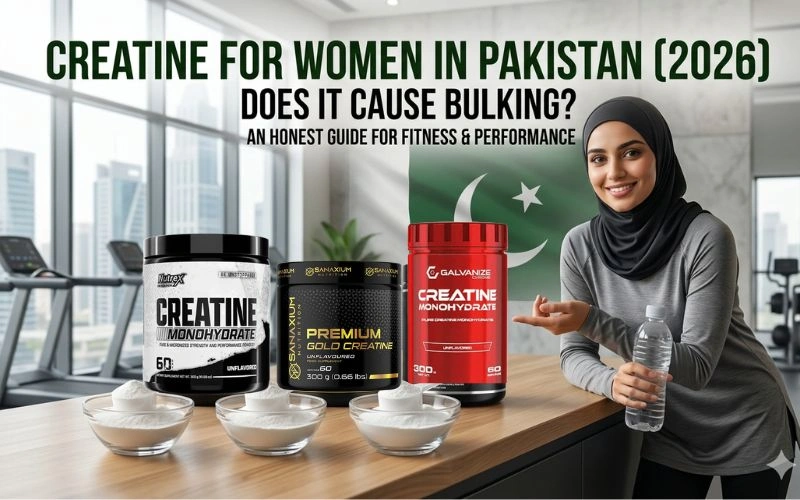
Let’s get the biggest fear out of the way first because it’s holding thousands of Pakistani women back from one of the most effective, safest supplements available. The fear is bulking. The truth? Creatine does not make women bulky. Full stop. This guide leads with that fact, backs it up with science, and then shows you exactly how creatine can fuel your energy, sharpen your mind, and help you build the lean, strong physique you’re actually after.
Table of Contents
The Biggest Myth: ‘Creatine Makes Women Bulky’
This myth has survived for decades, spread through gym locker rooms and WhatsApp groups, and it has almost no scientific basis especially for women. Here’s why it persists and why you can confidently ignore it.
Women carry roughly 10 to 20 times less testosterone than men. Testosterone is the primary anabolic hormone responsible for large, visible muscle growth. Without it in meaningful quantities, your body simply cannot build the kind of size that the word ‘bulky’ implies no matter how much creatine you take. Creatine does not change your hormones. It does not override your biology.
- Creatine increases your muscles’ energy supply it does not stimulate muscle cell growth on its own
- Large muscles require a sustained caloric surplus, heavy progressive overload, and high testosterone
- The 1–2 kg weight increase beginners notice is water retained inside muscle cells, not fat or new mass
- This intramuscular water makes muscles appear fuller, tighter, and more defined the opposite of soft bulk
That initial scale increase is the single biggest reason women panic and stop using creatine. But understanding what it actually is intracellular water that improves the look and performance of your muscles completely reframes the situation. Your clothes will not suddenly feel tight. Your waist will not expand. You will look more toned, not larger.

Myth vs. Fact: Creatine for Women Full Breakdown
Below is a complete reference table addressing every major myth women encounter about creatine. Share this, bookmark it, or screenshot it because these questions come up constantly.
| ❌ Myth | ✅ Fact | 📖 Science Says |
| Creatine makes women bulky | It builds lean tone, not size | Women lack testosterone needed for large muscle growth |
| Creatine is a steroid | It’s a natural food compound | Found in red meat & fish; classified as a dietary supplement |
| It causes water bloating | Water goes inside muscle cells | Intramuscular water makes muscles look firmer and fuller |
| You must do a loading phase | 3g/day consistently is enough | Studies show equal saturation with or without loading |
| Creatine damages kidneys | Safe for healthy kidneys | 20+ years of research confirms no kidney harm in healthy adults |
| It affects hormones/periods | Zero hormonal interference | No effect on oestrogen, testosterone, or menstrual cycle |
| Hair loss risk for women | Not supported in women | One male-only study; never replicated in women |
More Energy for Workouts How Creatine Actually Works
If you’ve ever hit a wall mid-workout, that moment where the last few reps feel impossible and your energy just evaporates creatine directly addresses that problem at a cellular level.
Your muscles use a molecule called ATP (adenosine triphosphate) as their primary fuel for short, intense efforts. ATP depletes very rapidly in roughly 8 to 10 seconds of maximum effort. When your phosphocreatine stores are full (which is what creatine supplementation achieves), your body regenerates ATP faster, allowing you to sustain higher effort for longer.
In practical terms for Pakistani women hitting the gym or doing home workouts, this means more reps on the final set, more power in each interval, and less of that total-drain feeling that makes you cut workouts short. The effect is subtle in isolation but compounds significantly over weeks and months of training.
- Improved ATP regeneration = more power output per workout
- Better performance in HIIT, weight training, crossfit, and circuit sessions
- Reduced perception of effort workouts feel hard but manageable
- Pairs especially well with pre-workout nutrition for women training fasted
Real Strength Gains What the Research Shows Women
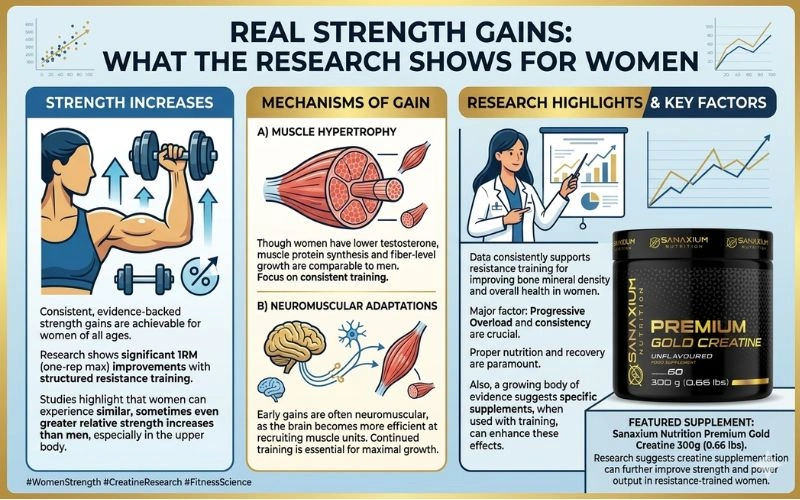
Creatine women benefits in the strength department are well-documented across dozens of peer-reviewed studies. Women who combine consistent creatine supplementation with resistance training consistently outperform those who train without it not just marginally, but meaningfully.
A landmark meta-analysis covering multiple studies on women specifically found that creatine supplementation increased upper body strength by approximately 20–25% more than training alone, and lower body strength by 15–20% more. These are not bodybuilder numbers these are functional, everyday strength improvements that translate to carrying groceries, climbing stairs, and staying injury-free.
For women in Pakistan focused on body composition getting leaner while building definition this matters enormously. More strength means better muscle stimulus during training, which means more lean muscle tissue, which means a higher resting metabolic rate. You burn more calories at rest. The effect is cyclical and compounding.
- Faster progression on key lifts (squats, lunges, overhead press, rows)
- Greater training volume capacity more work done per session
- Faster recovery between sessions, enabling higher training frequency
- Functional strength improvements that reduce injury risk in daily life
Mental Sharpness The Benefit Nobody Talks About
This is the creatine benefit that surprises most women and it’s arguably the most exciting development in recent supplement research. Your brain uses a significant amount of creatine for its own energy metabolism. When brain phosphocreatine levels are optimised, cognitive performance improves.
Studies have shown that creatine supplementation improves working memory, processing speed, and mental fatigue resistance particularly under stress or sleep deprivation. For Pakistani women managing demanding workloads, family responsibilities, and intense study or career schedules, this is a genuinely practical benefit.
Research is especially compelling for: women during the luteal phase (the week before menstruation), when brain fog and mood dips are common; perimenopausal women experiencing cognitive changes; vegetarian women, who have lower baseline creatine due to minimal meat intake; and anyone dealing with high mental load and chronic fatigue.
- Improved working memory and information processing speed
- Reduced mental fatigue during long work or study sessions
- Potential mood support research links creatine to serotonin pathway support
- Especially impactful for vegetarians with naturally low dietary creatine
Women’s Creatine Dosage Guide 3g vs 5g Explained
One of the most practical things this guide can give you is clarity on dosage because most recommendations are calibrated for men, and women’s needs are different. The standard 5g/day figure comes from research predominantly conducted on men with higher body mass and muscle mass than the average woman.
For most Pakistani women, 3 grams per day is sufficient to fully saturate muscle creatine stores over 3–4 weeks. This lower dose also reduces the likelihood of any mild digestive discomfort some beginners notice at 5g. More advanced or heavier women, or those doing high-volume strength training, can move to 5g but 3g is the right starting point.
No loading phase needed. Old protocols called for 20g per day for 5 days to load quickly. Current research shows that 3g daily achieves the same saturation by week 4 without any of the digestive stress the loading phase causes. Consistency beats speed here.
| Profile | Daily Dose | Best Time | Mix With |
| Women (beginner) | 3 g / day | Post-workout or morning | Water, juice, or protein shake |
| Women (advanced) | 3–5 g / day | Post-workout | Carb drink for better uptake |
| Men (general) | 5 g / day | Post-workout | Water or carb drink |
| Women 35+ / perimenopausal | 3–5 g / day | Any time, with food | Milk or yoghurt smoothie |
| Ramadan use (women) | 3 g / day | Sehri or Iftar | Water with dates for fast uptake |
Key rule: Take creatine every day, including rest days. Muscle creatine stores require consistent maintenance. Skipping days is the single most common mistake that reduces effectiveness.
Using Creatine During Ramadan A Practical Guide for Pakistani Women
Ramadan presents a specific challenge for women who supplement: you’re fasting for 14–16 hours, your hydration patterns change, and your training schedule shifts. The good news is creatine is entirely compatible with Ramadan use it just requires a small adjustment in timing.
Because creatine is tasteless, mixes instantly in water, and requires no specific food pairing to work, it integrates naturally into either Sehri or Iftar. The only real consideration is hydration creatine draws water into muscle cells, so ensuring adequate fluid intake during non-fasting hours is important.
Sehri Option
Take 3g of creatine with your Sehri meal and plenty of water. This ensures your muscles enter the day with full phosphocreatine stores. If you train in the late evening after Iftar, this approach maintains your stores throughout the day.
Iftar Option
If you train after Iftar (which many Pakistani women do), taking creatine immediately after breaking your fast mixed with water and a date or two for the carbohydrate-assisted uptake is equally effective and works beautifully with the natural Iftar routine.
- Dose stays the same: 3g/day no need to adjust for Ramadan
- Prioritise hydration: aim for 2–2.5 litres during non-fasting hours
- Creatine does not break your fast (it contains no calories)
- Muscle creatine stores remain elevated even on days you don’t train
- No loading needed consistent daily use is all that’s required
One common concern: does creatine cause extra thirst during fasting hours? The intramuscular water retention stabilises within the first 1–2 weeks of use. After that, most women do not notice increased thirst beyond normal Ramadan levels, especially at the 3g dose.
Best Creatine Brands Available in Pakistan With PKR Prices
The supplement market in Pakistan has expanded significantly, but counterfeit products remain a concern. The brands below are widely available through trusted retailers and represent the best combination of purity, price, and accessibility for Pakistani women.
| Brand | Type | Size | Price (PKR) | Best For |
| Optimum Nutrition Micronised | Creatine Monohydrate | 300g | Rs. 13,800–10,800 | Beginners & daily use |
| Labrada Nutrition CreaLean | Strength Creatine Powder | 250g | Rs. 9,500–7,400 | Purity-conscious buyers |
| MuscleTech Platinum 100% | Creatine Monohydrate | 400g | Rs. 15,900–12,700 | Value per serving |
| Ultimate Nutrition | Micronised Monohydrate | 300g | Rs. 9,500–7,500 | Sensitive stomachs |
Prices vary by retailer and import batch. Always verify the purchase source before buying. For the best selection of authentic, quality-verified creatine in Pakistan, browse the options at
For the best selection of authentic, quality-verified creatine available in Pakistan, browse the full range at Nutritional World Pakistan a trusted retailer for genuine imported supplements with transparent product information.
What to Look For on the Label
- Creapure® certification mark guarantees pharmaceutical-grade German creatine monohydrate
- No proprietary blends the creatine dose should be clearly stated per serving
- Manufacturing certifications: GMP, Informed Sport, or NSF
- Avoid products listing ‘creatine blend’ or ‘creatine matrix’ these dilute the effective dose
If you’re unsure where to start, creatine monohydrate options here and filter by brand for detailed product breakdowns.
Who Should Avoid Creatine Important Precautions
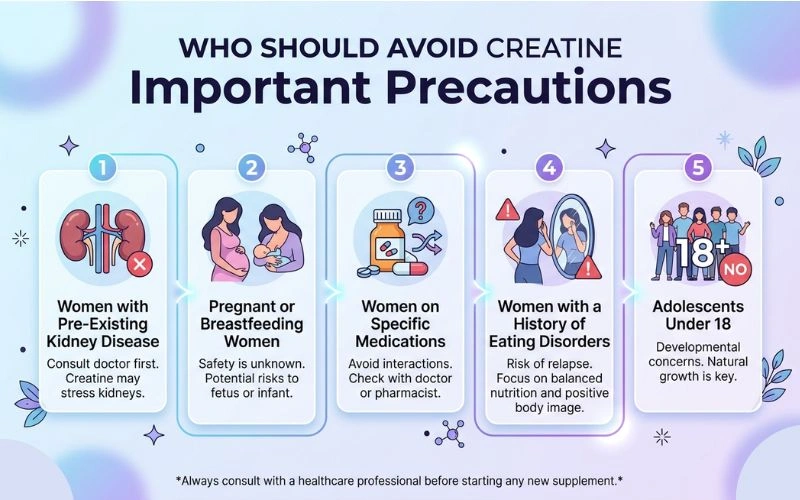
Creatine is safe for the vast majority of healthy women, but there are specific situations where caution or avoidance is warranted. Being clear about this is part of giving genuinely useful, trustworthy guidance and it matters for creatine for women is it safe conversations.
Women with Pre-Existing Kidney Disease
If you have been diagnosed with reduced kidney function, chronic kidney disease, or are on dialysis, creatine supplementation is not recommended without explicit medical approval. Creatine metabolism produces creatinine, which can elevate kidney biomarkers in blood tests and confuse clinical monitoring. Healthy kidneys handle this easily compromised kidneys may not.
Pregnant or Breastfeeding Women
There is insufficient research on creatine use during pregnancy and breastfeeding to make safety recommendations either way. Until more data exists, the cautious approach is to avoid supplementation during these periods. Consult your gynaecologist or GP before use.
Women on Specific Medications
- Nephrotoxic medications (drugs that stress the kidneys) consult your doctor
- Diuretics creatine’s water-retaining effect can interact with diuretic function
- Caffeine in very high doses some early research suggested it may reduce creatine uptake, though evidence is inconclusive
Women with a History of Eating Disorders
The scale increase from intramuscular water retention even though it is benign can be psychologically distressing for women with a history of disordered eating. If your relationship with the scale or body weight is complicated, speak with a healthcare professional before beginning creatine.
Adolescents Under 18
Creatine research focuses on adult populations. While no specific harm has been demonstrated in adolescents, standard guidance is to wait until adulthood before supplementing, allowing natural development without intervention.
Bottom line: If you are a healthy adult woman who exercises, creatine is very likely safe for you. If any of the above categories apply, a brief conversation with your doctor costs nothing and gives you certainty.
Final Verdict Is Creatine Right for You?
The evidence is clear, the myths are debunked, and the practical path forward is simple. Creatine for women Pakistan is one of the most well-supported, cost-effective decisions a woman who trains can make in 2026. It won’t bulk you up. It will make you stronger, sharper, and more energetic and it costs less per day than a cup of coffee.
- Start with 3g per day no loading, no complicated protocol
- Choose creatine monohydrate from a certified brand available in Pakistan
- Take it consistently, every day including rest days
- Expect 3–4 weeks for full saturation and noticeable performance improvement
- Ignore the scale evaluate results by how you lift, how you feel, and how you look
Ready to start? Find quality creatine monohydrate sourced from trusted brands at Nutritional World Pakistan. Filter by goal, brand, and budget and get started on something that will genuinely change how you train.
Frequently Asked Questions
1. Does creatine make women bulky in Pakistan?
No. Women lack the testosterone levels required to build large, bulky muscles. Creatine improves muscle energy and recovery. It produces a lean definition, not size. The 1–2 kg initial weight gain is intramuscular water that makes muscles appear tighter and more toned, not larger or softer.
2. What is the correct creatine dose for women?
3 grams per day is the optimal starting dose for most Pakistani women lower than the 5g recommended for men due to differences in body mass and muscle mass. No loading phase is needed. Simply take 3g daily, consistently, and full muscle saturation occurs within 3–4 weeks without any digestive discomfort.
3. Can I use creatine during Ramadan?
Yes. Taking 3g at Sehri or Iftar both work equally well. Creatine contains no calories, does not break your fast, and integrates naturally into either meal. Prioritise hydration during non-fasting hours. The dose remains the same as non-Ramadan periods; no adjustment is needed.
4. Which creatine brand is best for women in Pakistan?
Optimum Nutrition Micronised Creatine and Myprotein Creapure® grade are the top picks for quality and availability. Prices range from Rs. 4,200 to Rs. 7,000 depending on brand and size. Buy from verified retailers to avoid counterfeit products. Creapure® certification is the gold standard for purity.
5. Is creatine safe for women with PCOS or thyroid conditions?
Current research does not show any negative interaction between creatine and PCOS or thyroid conditions. However, because both conditions involve hormonal complexity, the prudent approach is to consult your endocrinologist or gynaecologist before starting. For healthy women without these conditions, creatine is extensively confirmed as safe.