














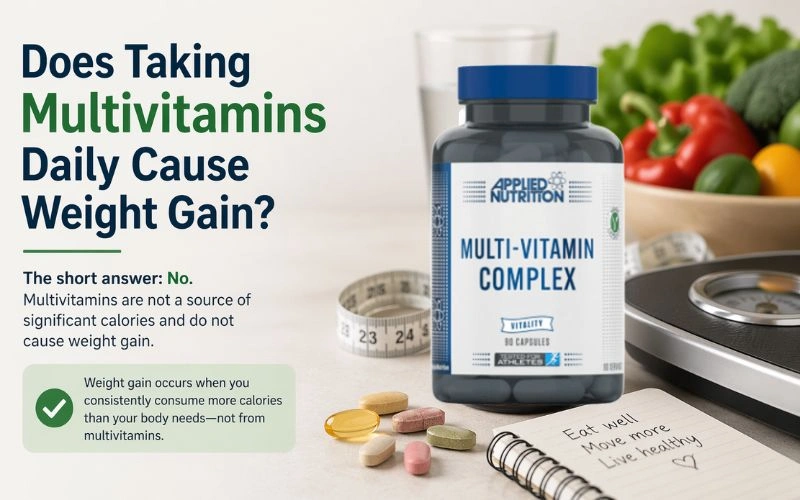
The most commonly asked vitamin supplements in Pakistan question that has nothing to do with deficiency is this one. People notice they have gained a few kilograms since starting their multivitamin tablets and immediately wonder whether the supplement is the cause.
Short answer No, taking a daily multivitamin does not directly cause weight gain. A standard multivitamin tablet contains virtually zero calories and no macronutrients that contribute to fat storage. Any weight change you notice after starting a multivitamin is almost certainly coming from somewhere else in your diet or lifestyle. That said, there are indirect and nuanced ways in which correcting nutrient deficiencies through a multivitamin can influence your appetite, energy levels, and metabolism, and understanding these helps explain why some people feel different after starting one.
Table of Contents
What a Multivitamin Actually Contains
To understand why a multivitamin cannot directly cause weight gain, it helps to look at what is actually in one. A standard multivitamin tablet contains micronutrients: vitamins and minerals measured in milligrams or micrograms. It does not contain meaningful amounts of protein, fat, or carbohydrates, which are the three macronutrients that provide calories and drive changes in body weight.
A typical multivitamin tablet delivers somewhere between 5 and 20 calories per serving, almost entirely from the coating or fillers used to bind the tablet. Even if you consumed three tablets a day for an entire year, the caloric contribution would be negligible compared to any single meal. There is no biochemical mechanism by which the vitamins and minerals themselves are converted into stored body fat.
How vitamins support bodily functions is primarily catalytic. They enable and regulate metabolic processes rather than providing fuel for them. Vitamin D supports calcium absorption. B vitamins enable energy metabolism. Zinc supports immune function and hormone regulation. None of these actions add caloric load to your body.

Why Some People Gain Weight After Starting a Multivitamin
While multivitamins themselves do not cause weight gain, there are genuine indirect pathways through which correcting deficiencies can lead to changes in body composition or weight perception. These are worth understanding rather than dismissing.
Correcting Deficiency Restores Appetite
Certain nutrient deficiencies suppress appetite as a side effect. When those deficiencies are corrected, appetite returns to its natural level, which can feel like the supplement is making you hungrier.
Vitamin D deficiency in particular has been linked to disrupted appetite regulation. Low vitamin D is associated with elevated levels of leptin resistance, which impairs the body’s ability to register fullness. When vitamin D is corrected, some people experience a temporary period of increased appetite as their hormonal signalling normalises. This is not the vitamin causing hunger. It is the body recalibrating after a period of suppressed signalling.
B12 deficiency causes fatigue, low energy, and reduced activity tolerance. People who are severely B12 deficient often have suppressed physical activity as a result. When B12 is corrected and energy levels rise, appetite frequently increases to match the newly recovered activity level. If food intake rises without a corresponding increase in physical output, weight gain follows, but the cause is the restored energy, not the vitamin itself.
Correcting Deficiency Improves Energy and Reduces Fatigue
Iron deficiency is one of the most common nutritional deficiencies in Pakistan, particularly among women. Anaemia caused by iron deficiency produces chronic fatigue, reduced exercise tolerance, and reduced motivation for physical activity. When iron intake is corrected through a multivitamin containing iron, energy levels rise, people become more physically active, and their muscle mass may increase over time. Lean muscle mass adds weight on the scale, but it is not fat gain.
This is one of the most misunderstood reasons people associate multivitamin use with weight gain. The scale goes up, but the reason is improved physical function and muscle development rather than any direct effect of the supplement.
Hormonal Regulation and Body Composition
Some vitamins and minerals play a direct role in hormone regulation, and hormones have a profound influence on body weight and fat distribution. Zinc supports testosterone production, and adequate zinc levels are associated with healthier body composition in both men and women. Low testosterone and weight gain are closely linked, and correcting a zinc deficiency that was suppressing testosterone may improve body composition over time.
Hormonal balance and diet operate through a complex feedback system that micronutrients support at multiple levels. Magnesium affects insulin sensitivity. Vitamin D influences cortisol regulation. B vitamins support thyroid hormone metabolism. When any of these micronutrients are consistently deficient, the resulting hormonal disruption can contribute to fat accumulation, particularly around the abdomen.
Correcting these deficiencies through a multivitamin does not add fat. It removes a hormonal obstacle to healthy body composition. This is a subtle distinction but an important one.
The Pakistan-Specific Deficiency Context
Vitamin D deficiency in Pakistan is unusually prevalent despite the country’s sunny climate. The reasons include sun avoidance, full-coverage clothing, limited outdoor physical activity among certain populations, and very few vitamin D-rich food sources in the typical Pakistani diet. B12 deficiency is similarly common, even among meat-eaters, due to cooking methods that degrade the vitamin and gut absorption issues that are more widespread than most people realise.
These two deficiencies, when corrected simultaneously through a daily multivitamin, can produce noticeable changes in how a person feels, moves, and eats. The weight changes some people attribute to the multivitamin are almost always the downstream effects of these restored functions rather than any direct caloric contribution from the tablet itself.
Water Retention and the Scale
One reason people occasionally notice a small increase in weight shortly after starting a multivitamin is water retention. Certain B vitamins, particularly B1 (thiamine) and B6, influence how the body manages fluid balance. Correcting a deficiency in these vitamins can temporarily increase intracellular water retention as cellular function normalises.
This type of water weight is not fat. It does not reflect a change in your actual body composition and typically stabilises within two to four weeks. If you weigh yourself after starting a multivitamin and notice a kilogram or two of increase that was not there before, checking whether your clothes fit the same way is a more meaningful indicator of actual body fat change than the number on the scale.
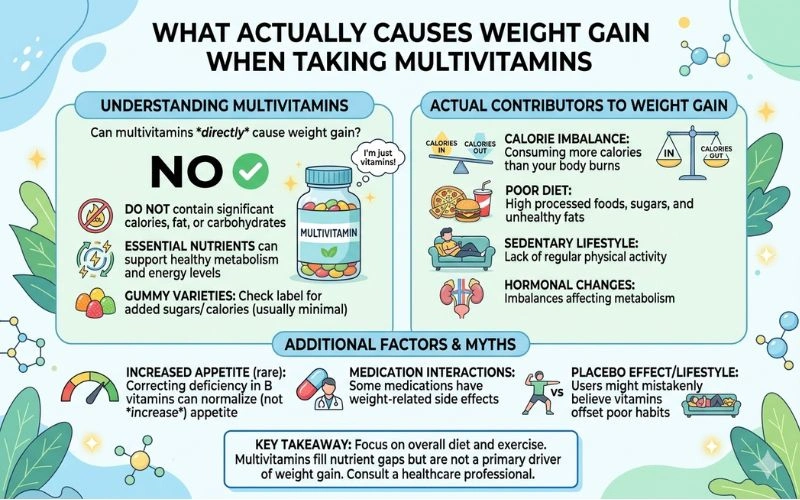
What Actually Causes Weight Gain When Taking Multivitamins
The most common explanation for weight gain that coincides with starting a multivitamin is behavioural rather than biochemical. Many people begin a health routine that includes a multivitamin alongside other lifestyle changes: joining a gym, eating more regularly, or increasing caloric intake as part of a bulking or recovery phase.
When these changes happen simultaneously, the multivitamin becomes an easy but incorrect explanation for the weight change. Supplements versus a balanced diet is a frequently misunderstood relationship. Supplements work alongside diet, not independently of it. If your caloric intake has increased, your activity level has decreased, or your sleep quality has changed around the same time you started a multivitamin, any of these factors is far more likely to explain the scale change than the supplement.
Common Misconceptions Worth Addressing
The concern that vitamins cause weight gain is part of a broader pattern of supplement-related misconceptions that are worth clearing up directly.
Collagen and weight gain is another frequently Googled question that follows similar logic. A supplement is started, weight changes are noticed, and a causal connection is assumed. In almost every case the causal chain is elsewhere. Supplements that contain meaningful calories, like mass gainers, meal replacements with added sugars, or protein powders consumed in addition to a full diet, can contribute to caloric surplus and weight gain. A micronutrient tablet cannot.
Gut health is another variable worth considering. Some people experience mild bloating or water retention when starting a multivitamin that contains iron or high-dose magnesium. Both minerals affect gut motility and fluid balance in ways that can temporarily alter how full or heavy you feel. This is not fat gain. It is a digestive adjustment that resolves as your body adapts to the supplement.
When to Take Your Multivitamin for Best Results
Timing your multivitamin correctly reduces the chance of digestive discomfort and improves absorption of fat-soluble vitamins like A, D, E, and K, which require dietary fat to be properly absorbed. Building it into your morning routine with a meal that contains some fat, whether eggs, nuts, a drizzle of oil, or full-fat yoghurt, is the most practical approach for most people.
Avoid taking it on a completely empty stomach if your formula contains iron or zinc. Both are well-documented gastric irritants that cause nausea in many people when taken without food, which then leads to the tablet being abandoned entirely.
Which Multivitamin to Choose
Not all multivitamins are equally formulated, and the quality of the nutrient forms used determines how much of each vitamin your body actually absorbs and uses. A well-formulated product uses methylcobalamin for B12, D3 rather than D2, chelated minerals for better absorption, and avoids excessive doses of any single fat-soluble vitamin.
The best multivitamin for most Pakistani gym goers and active adults is one that covers the nutrients most commonly deficient in the local population without adding unnecessary fillers or excessive megadoses. Buying from a verified importer ensures the product matches its label.
Frequently Asked Questions
Can a multivitamin make me feel hungrier?
Yes, indirectly. Correcting deficiencies in B12, vitamin D, or iron can restore appetite and energy levels that were suppressed by those deficiencies. If you feel hungrier after starting a multivitamin, it is your body’s metabolism running more efficiently rather than the vitamin stimulating appetite directly. Managing that increased appetite through balanced food choices prevents it from translating into unwanted weight gain.
Will stopping my multivitamin help me lose weight?
No. A multivitamin does not contain enough calories to meaningfully affect your weight. If you are trying to lose weight, stopping your multivitamin removes a useful nutritional safety net without addressing any of the actual drivers of weight gain, which are always related to caloric intake, activity levels, sleep, and hormonal health.
My weight went up by 1 to 2 kg in the first few weeks of taking a multivitamin. Is that normal?
A small and temporary increase in scale weight after starting a multivitamin is likely water retention from B vitamin and mineral corrections, increased appetite driving marginally higher food intake, or increased physical activity as energy levels improve. Unless your clothing fits noticeably tighter at the same time, this is almost certainly not fat gain and will typically stabilise within three to four weeks.
Are there any vitamins that genuinely influence fat metabolism?
B vitamins play a role in converting food into usable energy, and deficiencies can slow this process. Vitamin D is linked to insulin sensitivity and fat cell regulation. These effects mean that correcting deficiencies through a multivitamin can support a healthier metabolic environment for fat loss, but they do not create fat loss on their own in the absence of a caloric deficit.
Is a multivitamin enough for a complete supplement routine?
A daily multivitamin is an excellent nutritional foundation, particularly in the Pakistani context where specific deficiencies like vitamin D and B12 are widespread. For an active gym goer, pairing it with a quality protein source and omega-3 covers the most important bases before adding any performance-focused supplements. If you are building your first routine, a beginner supplement routine that starts with these three is a well-supported and cost-effective starting point.