













Table of Contents
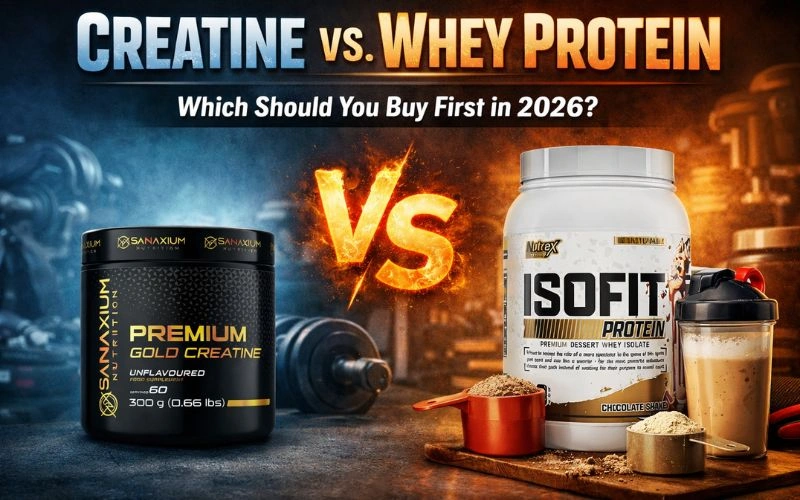
Creatine vs. Whey Protein: Which Should You Buy First in 2026?
Walking into Pakistan’s leading online supplement store or scrolling through countless product pages can feel overwhelming, especially when you’re a beginner trying to decide between creatine price in Pakistan and whey protein. Both are among the most popular muscle building supplements in Pakistan, but which one deserves your hard earned rupees first? The decision gets even more confusing once you start comparing benefits, results, and especially the whey protein price in Pakistan, which can vary widely depending on brand authenticity, import status, and product quality.
Many beginners assume they need both supplements right away, but your choice should really depend on your fitness goal, daily diet, and budget. Whey protein mainly helps you meet your daily protein requirements for muscle repair and growth, while creatine boosts strength, power, and workout performance. Understanding how each one works, and what you are actually paying for, helps you make a smarter, goal oriented purchase instead of an impulsive one.
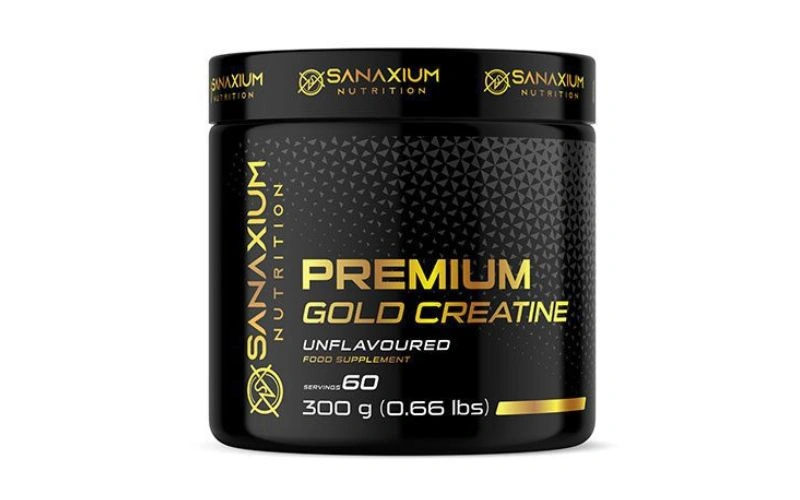
Which Supplement Should Beginners Buy First?
If you’re deciding where to spend your first supplement budget, here is a quick answer before we get into the full breakdown.
If you can only afford one supplement right now, buy creatine monohydrate first if you’re already eating enough protein from whole foods (roughly 0.7 to 1g per pound of bodyweight). Choose whey protein first if you struggle to hit your daily protein target through regular meals.
Here’s the simple truth: creatine is the most researched, cost effective performance supplement available, typically costing Rs. 5,000 to 8,000 for a 3 month supply at Nutritional World. Whey protein is essentially convenient food that helps you hit protein targets, with prices ranging from Rs. 25,000 to 40,000 for a 5lb container.
Decision Framework:
- Already eating 120 to 150g+ protein daily? Start with creatine monohydrate.
- Struggling to get enough protein? Start with whey protein.
- Have Rs. 30,000 to 40,000 a month for supplements? Buy both through Nutritional World’s special offers.
Now let’s look at why these recommendations make sense, based on the science, the real cost breakdown, and what actually happens in your body.
Understanding the Basics: What Are These Supplements?
Before comparing results and pricing, it helps to know exactly what each product is and where it comes from.
Both are concentrated sources of specific nutrients or compounds designed to support health, performance, or recovery beyond what your regular diet alone provides.
What Is Creatine and How Does It Work?
Here’s what happens inside your muscles once you start taking it.
Creatine is a compound your body already produces, and it’s also found in foods like red meat and fish. Your muscles store creatine as phosphocreatine, which helps regenerate ATP, the primary energy currency your cells rely on during high intensity exercise.
When you supplement with creatine monohydrate (the most studied form available at Nutritional World), you saturate your muscle stores by about 20 to 40%. Once saturated, this allows you to:
- Perform 1 to 2 additional reps per set
- Recover faster between sets
- Generate more power during explosive movements
- Support muscle growth through increased training volume
The key insight: creatine doesn’t directly build muscle. It helps you train harder and recover faster, which leads to better results over time. Research on how creatine actually works inside the body shows that combining it with resistance training produces significantly greater strength gains than training alone.
What Is Whey Protein and How Does It Work?
Now let’s look at the other side of the comparison and how whey earns its reputation as the go to post workout supplement.
Whey protein is a complete protein derived from milk during cheese production. It contains all nine essential amino acids your body needs but cannot produce on its own. Whey absorbs quickly, usually within 1 to 2 hours, which is why it’s so popular right after training.
There are three main types available:
- Whey Concentrate: 70 to 80% protein, contains some lactose and fat
- Isolate Protein: 90%+ protein, lower lactose and fat
- Hydrolyzed Protein: pre digested for faster absorption, most expensive
Whey protein stimulates muscle protein synthesis, the process where your body repairs and rebuilds muscle tissue after training. It’s worth understanding that whey is simply a convenient protein source. Nothing magical happens with the powder that doesn’t also happen with chicken breast or Greek yogurt, and this is covered in more detail when comparing what protein supplements actually do for your body.
The Science-Backed Benefits Comparison
Here’s how each supplement performs when you compare the clinical evidence side by side.
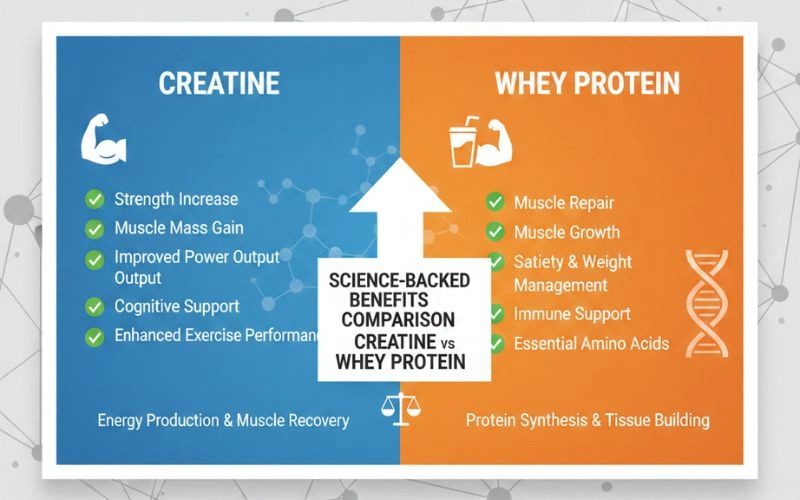
Creatine Benefits: What the Research Shows
Few supplements have been studied as extensively as this one, so let’s look at what the data actually says.
Creatine has over 1,000 published studies backing its efficacy, and sports nutrition bodies routinely describe it as one of the most effective ergogenic supplements currently available.
Strength and Power: a meta analysis of 22 studies found creatine supplementation increased bench press strength by an average of 5 to 10% over 4 to 12 weeks. For someone benching 60 kg, that’s an additional 3 to 6 kg of lifting capacity.
Muscle Growth: by enabling higher training volumes, creatine indirectly supports muscle hypertrophy, and people following a consistent creatine dosing and loading routine often see 1 to 2 kg (2 to 4.5 lbs) of lean muscle gain over 8 to 12 weeks when combined with resistance training.
Cognitive Performance: emerging research suggests creatine may improve working memory and reduce mental fatigue, particularly during sleep deprivation or demanding cognitive tasks.
Cost Effectiveness: at 5g daily, a 300g container (Rs. 5,000 to 8,000 at Nutritional World) lasts 2+ months, making it one of the cheapest energy supplements available.
Whey Protein Benefits: What the Research Shows
Whey’s benefits are more straightforward, but no less important for anyone building muscle.
Whey protein’s benefits are well established.
Muscle Protein Synthesis: studies show 20 to 25g of whey protein maximally stimulates muscle protein synthesis in most individuals. The leucine content, roughly 2 to 3g per serving, plays a key role in triggering this anabolic response.
Convenient Protein Intake: the average Pakistani male needs 120 to 180g of protein daily for muscle building, and getting there from whole foods alone takes real planning. If you are working out how much protein your body actually needs each day, whey protein provides 20 to 30g per shake, making that daily target much easier to reach.
Recovery Support: post workout protein, whether from whey or food, helps reduce muscle soreness and supports adaptation to training stress.
Satiety and Weight Management: protein is the most satiating macronutrient. Research from the American Journal of Clinical Nutrition found that increased protein intake promoted fullness and supported fat loss during caloric restriction.
Important caveat: these benefits apply to protein in general, not exclusively whey. You could get identical results from chicken, eggs, or plant proteins, which is why comparing whey against other protein sources like collagen is worth doing before you commit to one product.
Side-by-Side Comparison: Creatine vs. Whey Protein
To make the decision easier, here’s how the two supplements stack up across the factors that matter most.
| Factor | Creatine Monohydrate | Whey Protein |
| Primary Purpose | Performance enhancement | Meet protein requirements |
| Cost at Nutritional World | Rs. 5,000 to 8,000 (300g) | Rs. 25,000 to 40,000 (5lb) |
| Duration | 60+ days | 30 to 60 days |
| Daily Dosage | 3 to 5g | 20 to 50g (as needed) |
| Timing Importance | Low (anytime works) | Moderate (spread throughout day) |
| Results Timeline | 2 to 4 weeks | Ongoing (meets dietary needs) |
| Replaceability | Difficult from food alone | Easy (any protein source) |
| Mixing Quality | Dissolves easily | Varies by brand |
| Safety Profile | Excellent (extensively studied) | Excellent (whole food derivative) |
Cost Analysis: Which Offers Better Value in Pakistan?
Let’s break down the real world economics for Pakistani consumers.
Creatine: a quality 300g container of creatine monohydrate costs Rs. 5,000 to 8,000 at Nutritional World and provides 60+ servings at 5g each. That works out to Rs. 83 to 133 per day, or roughly Rs. 2,500 to 4,000 per month.
Whey Protein: a standard 5 lb container with 25g protein per serving costs Rs. 25,000 to 40,000 and provides about 70 servings. Using one serving daily works out to Rs. 357 to 571 per day, or Rs. 10,700 to 17,100 per month.
Value Perspective: for the monthly cost of whey protein, you could buy 2 to 3 months of creatine. That said, this comparison isn’t entirely fair since the two serve different purposes: creatine is a performance enhancer while whey is essentially food.
Which Should YOU Buy First? Decision Framework
Start with the supplement that addresses your primary goal or gap first, then add the other gradually as your budget and needs change.
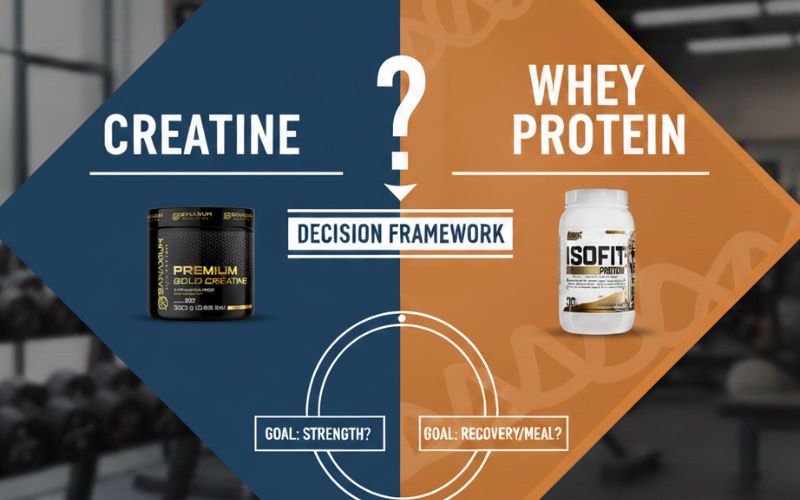
Buy Creatine First If…
Here’s when starting with creatine makes the most sense for you.
You’re already eating sufficient protein. If you consistently consume 0.7 to 1g of protein per pound of bodyweight through whole foods (chicken, fish, eggs, daal, legumes), adding more protein through supplements offers minimal extra benefit. Creatine, on the other hand, provides performance advantages you can’t easily replicate through diet alone.
You prioritize strength and performance. Powerlifters, CrossFit athletes, cricket players, and anyone focused on explosive power output will see measurable improvements from creatine supplementation within 2 to 4 weeks, especially once you understand the ideal time of day to take it for best results.
You’re on a tight budget. At under Rs. 4,000 a month from Nutritional World, creatine delivers exceptional return on investment. You can always add whey protein later once finances allow.
You want scientifically proven results. Creatine is arguably the most studied supplement in sports nutrition history, with overwhelming evidence behind its efficacy and safety, something worth confirming for yourself by looking into what long term studies actually say about creatine safety.
Buy Whey Protein First If…
On the other hand, these situations point toward starting with whey protein instead.
You struggle to meet daily protein targets. If you’re eating less than 0.7g of protein per pound of bodyweight, you’re likely limiting your own muscle building potential. Whey protein from Nutritional World provides an easy 20 to 30g boost toward your daily goal.
You have dietary restrictions limiting protein sources. Vegetarians, people with egg allergies, or anyone who dislikes meat often finds hitting protein targets difficult. Whey offers a convenient, complete protein source, and deciding between whey isolate and regular whey concentrate comes down to how sensitive you are to lactose.
You need portable, quick nutrition. Busy professionals, students, or parents who skip meals benefit from having ready to mix protein shakes on hand.
You’re recovering from intense training or injury. Adequate protein intake becomes critical during periods of tissue repair and muscle recovery, and some people also look into using slow-digesting casein protein overnight to support this.
Buy Both If…
For some people, the smartest move is skipping the either/or decision entirely.
If your monthly supplement budget exceeds Rs. 30,000 to 40,000, buying both makes excellent sense. Check Nutritional World’s stack offers, where the two work synergistically. Creatine enhances performance while protein supports recovery and growth, and this pairing is exactly what’s covered in a closer look at stacking creatine and whey for faster strength gains.
How to Use Each Supplement Effectively
Getting results depends on dosage and consistency just as much as the product itself, so here’s how to use each one correctly.
Creatine Dosage and Timing Guide
There are two common ways to start, depending on how quickly you want to see results.
Dosage Options:
- Loading Phase: 20g daily (4 doses of 5g) for 5 to 7 days, then 3 to 5g daily for maintenance
- Standard Protocol: 3 to 5g daily from day one (reaches saturation in 3 to 4 weeks)
Timing: recent research suggests timing doesn’t significantly impact results. Take creatine whenever convenient. Breakfast, pre-workout, or post-workout all work equally well.
Hydration: creatine draws water into muscle cells, so drink an additional 2 to 3 liters of water daily to support hydration.
Cycling: unnecessary. Continuous use is safe and keeps your muscle stores saturated.
Whey Protein Dosage and Timing Guide
Your ideal serving size depends on your bodyweight and how the rest of your day looks.
Calculate Your Needs: target 0.7 to 1.0g of protein per pound of bodyweight daily. If you weigh 75 kg (165 lbs), aim for 115 to 165g of protein total.
Serving Size: 20 to 30g per serving (one scoop of whey protein) provides an optimal muscle protein synthesis stimulus.
Timing Strategies:
- Post-workout: within 2 to 3 hours of training, ideally around the window that works best for your shake timing
- Between meals: when 4+ hours separate whole food meals
- Before bed: casein protein may support overnight recovery
Common Myths and Misconceptions Debunked
A lot of confusion around these two supplements comes from myths that simply don’t hold up under research, so let’s clear them up.
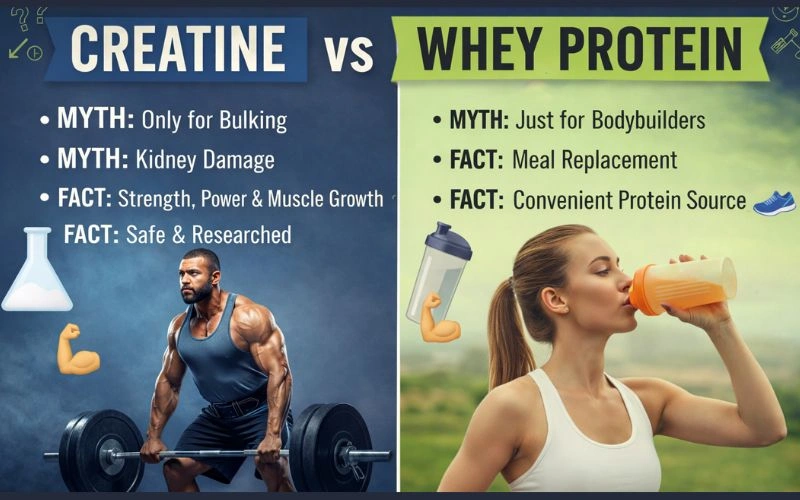
Creatine Myths Addressed
Here are the most common claims about creatine, and what the evidence actually shows.
“Creatine damages your kidneys”: false. Decades of research show creatine is safe for healthy individuals, though those with existing kidney conditions should understand how creatine interacts with kidney function before starting, and should consult a physician.
“You must cycle creatine”: false. Continuous use maintains muscle saturation without negative consequences.
“Creatine causes bloating”: partially true. Some people experience 1 to 2 lbs of water retention initially, and reviewing the most commonly reported creatine side effects can help set realistic expectations, as muscles store creatine along with water.
Whey Protein Myths Addressed
Whey protein has its own share of misconceptions worth clearing up too.
“You can only absorb 30g protein per meal”: nuanced. Your body absorbs nearly all protein consumed, but muscle protein synthesis maxes out around 20 to 30g per meal.
“Whey is only for bodybuilders”: false. Anyone struggling to meet protein requirements can benefit.
“Protein powder damages kidneys”: false for healthy individuals. Research shows high protein intake doesn’t harm healthy kidneys.
Shop Pakistan’s Trusted Supplement Store
Once you’ve decided which supplement to start with, where you buy it matters just as much as what you buy.
When buying your first supplement, quality and authenticity matter. Nutritional World stands out as Pakistan’s premier online supplement store, offering:
- 100% Halal-Certified Products: all supplements are halal-certified with no compromise on quality
- Authentic Imported Brands: direct imports from the USA, UK, and Europe, including Optimum Nutrition, MuscleTech, and Dymatize
- Best Prices in Pakistan: competitive pricing on creatine and whey protein
- Physical Stores: visit branches in Lahore, Islamabad, and Faisalabad
- Free Shipping: on orders above Rs. 2,500
Whether you need pre-workout supplements, BCAAs, fat burners, or weight gainers, Nutritional World has you covered, and their guide on building a supplement routine for gym beginners is a good next step once you’ve picked your first product.
Safety Considerations and Side Effects
Both supplements have strong safety records, but it still helps to know who should be more cautious.
Consult a doctor before use to avoid side effects or drug interactions.
Creatine Safety Profile
Here’s who should be extra careful before adding creatine to their routine.
Sports nutrition organizations confirm creatine monohydrate is safe for healthy adults when used as directed.
Who should consult a doctor first:
- Individuals with kidney disease
- People taking medications affecting kidney function
- Those with diabetes
Minor side effects (rare): stomach discomfort if taken on an empty stomach, temporary water retention.
Whey Protein Safety Profile
Whey is generally very safe, though a few groups should choose their product carefully.
Whey protein is a whole food derivative and is generally very safe. However:
Lactose intolerance: choose whey isolate (90%+ of lactose removed). Dairy allergies: avoid whey and consider plant-based alternatives. Quality concerns: buy from trusted sources like Nutritional World to avoid contamination.
Final Verdict: Our Evidence-Based Recommendation
Bringing everything together, here’s the recommendation most Pakistani beginners should follow.
For most Pakistani beginners who can only afford one supplement, start with creatine monohydrate if you’re already eating adequate protein from whole foods. It’s cheaper, more effective at enhancing performance, and provides benefits you can’t easily replicate through diet.
Choose whey protein first only if you’re genuinely struggling to consume 0.7g of protein per pound of bodyweight through normal eating.
Ideal approach:
- Optimize your whole food diet first
- Add creatine from Nutritional World for performance benefits
- Use whey protein as needed to hit daily protein targets
- Check special offers for bundled savings
Remember, supplements enhance an already solid foundation of training, nutrition, and recovery. Focus 90% of your energy on the fundamentals, and quality supplements from Nutritional World will provide that extra edge.
Visit Nutritional World today, Pakistan’s most trusted source for authentic, halal-certified muscle building supplements, delivered to your door with free shipping on orders over Rs. 2,500!
Frequently Asked Questions
Should a beginner take creatine or whey protein first?
If you already eat enough protein from whole foods, start with creatine monohydrate for performance gains. If you struggle to hit your daily protein target, start with whey protein instead.
Can I take creatine and whey protein together?
Yes. They serve different purposes, creatine for performance and whey for meeting protein targets, and many lifters use both together with no issues.
Which is cheaper, creatine or whey protein, in Pakistan?
Creatine is significantly cheaper, typically Rs. 2,500 to 4,000 per month, compared to Rs. 10,700 to 17,100 per month for whey protein at standard dosing.
Is creatine safe for daily long-term use?
Yes. Decades of research confirm creatine monohydrate is safe for healthy adults with continuous daily use, and cycling is not necessary.
How much whey protein should I take per day?
Most people take one to two servings of 20 to 30g per day, depending on how much protein they already get from whole foods and their total daily target.
Does creatine cause water retention or bloating?
Some people experience 1 to 2 lbs of initial water retention as muscles store creatine along with water. This is normal and not a health concern.