






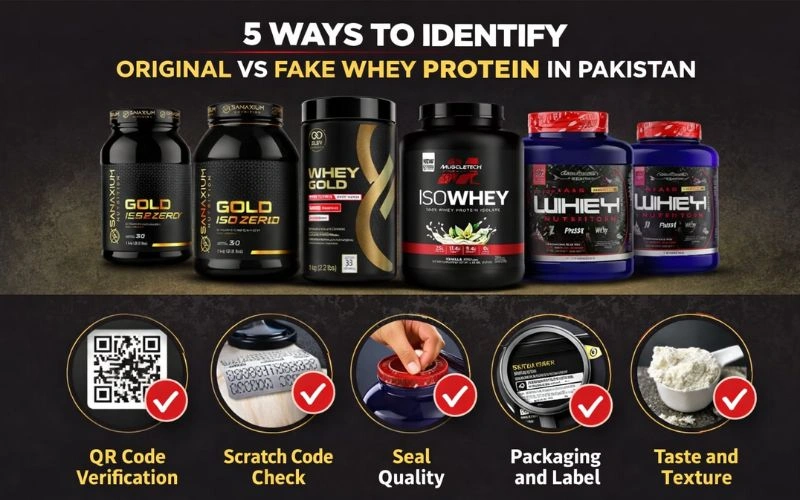
Worried you might be buying fake whey protein in Pakistan? The five most reliable checks are scanning the packaging QR code, confirming the importer sticker and DRAP registration number, inspecting print quality and the scoop, and comparing the price against the standard market rate. Any product that fails two or more of these checks should be treated as counterfeit until proven otherwise.
Table of Contents
Why Supplement Verification Is Crucial
Before diving into the verification methods, it helps to understand what is actually at stake. The consequences of buying counterfeit whey protein go beyond simply wasting money on a product that does not work.
- Counterfeit products are more common than most consumers realize. As demand for whey protein grows across Pakistan, so does the financial incentive for unscrupulous sellers to produce and distribute fake alternatives at scale.
- Fake supplements carry genuine health risks. Unregulated manufacturing environments mean counterfeit products can contain heavy metals, banned substances, or chemicals that cause digestive problems, kidney stress, and hormonal disruption over time.
- Economic losses compound the harm. Consumers who spend thousands of rupees on fake products lose both their investment and trust in the supplement market, making it harder for legitimate brands to serve them well.
Knowing how to spot a counterfeit product before recognizing fake imported products reach your shaker bottle is not just a purchasing skill, it is a health protection strategy. The five methods below cover every major checkpoint from packaging to price.
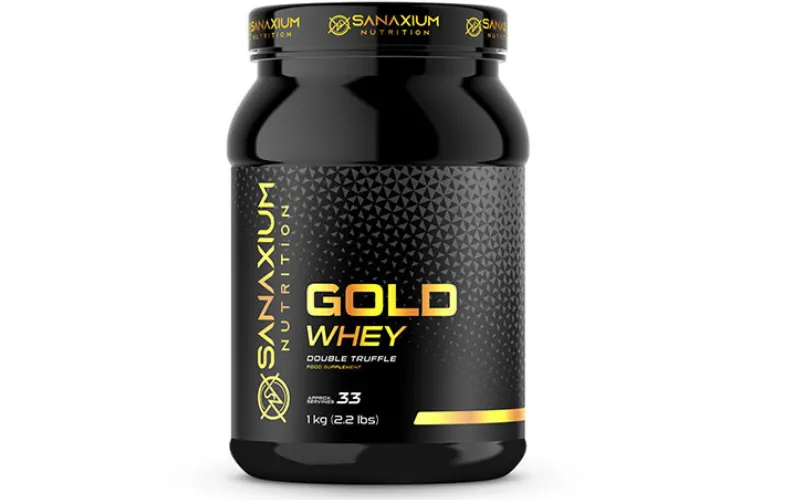
5 Ways to Identify Original vs Fake Whey Protein in Pakistan
Each of the following methods targets a different layer of product verification. Using them together gives you the most reliable result before committing to a purchase.
1. Check the QR Code and Product Verification Codes
Most reputable international supplement brands now include a QR code directly on their packaging that links to an official verification database. This is one of the fastest and most reliable authentication tools available to consumers.
- Scan the QR code using your smartphone camera. A legitimate product will redirect you to the manufacturer’s official verification page, confirming the batch number, production details, and authenticity status.
- Trusted authorized supplement sellers stock only verified products that carry functioning, brand-specific QR codes.
- Red flag to watch for: A missing QR code, a code that leads to a generic website, or a code that cannot be scanned are strong indicators of a counterfeit product. Legitimate brands invest in these systems precisely because consumers rely on them.
2. Look for Importer Stickers and Authenticity Seals
Genuine imported whey protein sold in Pakistan must carry specific documentation on its packaging that shows it has passed through proper regulatory channels. This is your second layer of protection.
- Importer stickers should be clearly visible on the packaging, showing the name and contact details of the authorized distributor. If you are buying from a licensed retailer, this sticker must be present.
- Tamper-proof seals should be intact on the container lid and along any sealed edges. These seals are difficult and expensive to replicate, which is why counterfeiters typically skip them or use low-quality substitutes.
- Missing importer information is not a minor oversight, it is a serious warning. Any product without an official distributor sticker or with broken seals should be rejected immediately.
3. Inspect the Packaging and Design Quality
Authentic whey protein products from established brands maintain strict quality control over their physical packaging. Counterfeiters often cut corners in this area, and the differences are visible once you know what to look for.
- Label printing quality on genuine products is sharp, with consistent colors, clean fonts, and no blurring. Compare the packaging to images on the brand’s official website if you are unsure.
- Spelling errors and design inconsistencies are among the most common tell-tale signs of a fake product. Counterfeit labels frequently contain subtle misspellings of the brand name, ingredient names, or company address.
- Key visual indicators include faded logos, irregular font sizes, and packaging materials that feel cheaper or thinner than expected. This applies equally to products like premium diet whey options and standard whey blends.
4. Pay Attention to the Scoop Placement and Measurement
This is one of the most overlooked verification checks, yet it reveals a great deal about whether a product is genuine. The scoop inside a container of whey protein is not a trivial accessory, it is calibrated specifically to deliver accurate serving sizes.
- Scoop placement in original products follows a consistent standard. Brands typically place the scoop either at the top of the powder, buried near the top layer, or secured inside the lid. Unusual placement or a scoop that appears to have been inserted carelessly is a warning sign.
- Serving size accuracy matters. The scoop’s physical volume should match the serving size printed on the label. If the stated serving is 30g but the scoop is visibly oversized or undersized, that is a sign the contents may not match what is advertised.
- Fake indicator: A scoop that is loosely placed, the wrong size, or missing entirely suggests the product was filled without adherence to original manufacturing standards. This also means the protein per serving you are consuming may be far less than claimed.
5. Research the Price Before You Buy
Price is one of the most reliable early indicators of a counterfeit product. Genuine whey protein carries a cost that reflects quality ingredients, import taxes, authorized distribution, and quality control processes.
- Compare prices across trusted, verified retailers to establish what the real market rate is for a specific product. Understanding current isolate and concentrate pricing helps you immediately identify outliers.
- Authentic whey protein is priced accordingly because it involves regulated import processes, third-party testing, and authorized distribution chains. Cutting any of these costs means cutting corners on the product itself.
- Price red flags: If a product is being sold at 30 to 50 percent below the typical market rate, especially from an unverified online seller or an unlicensed physical store, treat it as a counterfeit until proven otherwise. The risk is simply not worth the saving.
Original vs Fake Whey Protein Side-by-Side Comparison
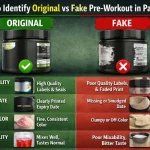
The table below summarizes the key differences across each verification criterion, making it easier to apply these checks during your next supplement purchase.
| Criteria | Original Whey Protein | Fake Whey Protein |
|---|---|---|
| Packaging Quality | High-quality tamper-proof packaging with clear, professional labeling | Low-quality packaging with signs of tampering or poor print quality |
| QR Code / Verification | Functional QR codes that link to official manufacturer databases | No QR code, invalid codes, or links leading to suspicious websites |
| Importer Stickers and DRAP Approval | DRAP approval numbers and importer sticker clearly visible on packaging | Missing DRAP approval, absent importer stickers, or forged documentation |
| Protein Content and Label Accuracy | Verified protein content with accurate, detailed nutritional information | Misleading protein content, poorly labeled or inaccurate nutritional data |
| Price | Priced within the standard market range reflecting genuine quality | Significantly cheaper than market rates, indicating likely counterfeiting |
| Taste and Solubility | Smooth texture, consistent taste, and clean mixability in liquid | Poor taste, clumping, and difficulty dissolving even with extended mixing |
Health Risks of Consuming Counterfeit Supplements
Understanding the physical consequences of fake whey protein reinforces why these verification steps matter. This is not simply about product quality, it is about protecting your body.
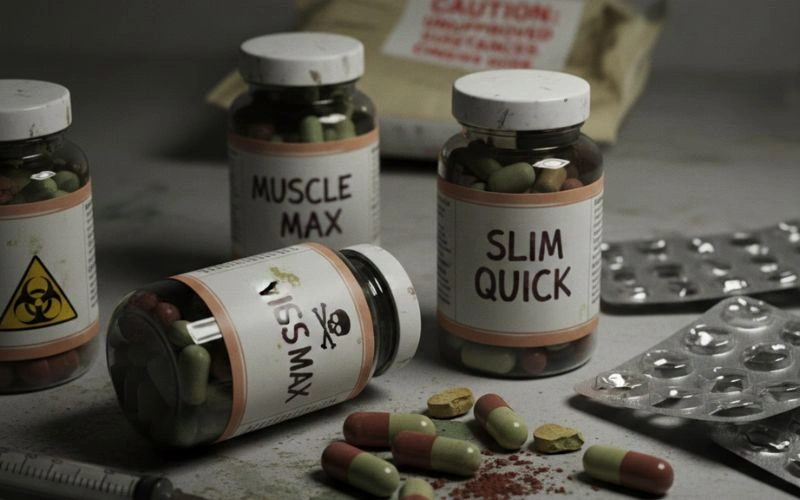
Counterfeit supplements are manufactured in uncontrolled environments with no quality oversight. They frequently contain harmful substances including heavy metals, industrial chemicals, or banned performance-enhancing compounds. Rather than delivering the overall health benefits of protein, these products can cause digestive damage, stress the kidneys, and disrupt hormonal balance over prolonged use.
Beyond these direct harms, counterfeit whey protein almost never contains the protein concentration it claims. The actual protein content may be diluted with cheap fillers or replaced with inferior nitrogen-spiked compounds that inflate the protein reading on lab tests without delivering usable amino acids. Anyone weighing how whey and collagen protein differ will appreciate that the source and quality of protein matters as much as the quantity claimed on the label.
Economic and Trust Damage Caused by Fake Supplements in Pakistan
The effects of counterfeit supplements extend far beyond individual consumers. The entire supplement ecosystem in Pakistan suffers when fake products gain a foothold in the market.
Market Trust Erosion
When consumers cannot reliably distinguish genuine products from counterfeits, their confidence in all supplement brands deteriorates. Legitimate retailers and manufacturers who invest in authentic supply chains, third-party testing, and proper importation end up competing against operators who bear none of those costs. This forces reputable brands to spend more on consumer education and product differentiation, driving up costs while reducing the trust that makes those investments worthwhile in the first place.
Consumers who learn to appreciate the standards behind genuine imported supplements are better placed to support the brands that consistently deliver quality, which in turn sustains a healthier market for everyone.
Reputation Damage to Authentic Brands
Counterfeit products sold under well-known brand names do direct reputational harm to those brands. When a consumer buys a fake product believing it is genuine and experiences poor results or adverse effects, their disappointment is attributed to the brand, not the counterfeit operation. This creates a cycle where legitimate companies lose customers to fakes and are then blamed for the fake product’s failures.
Price pressure makes this worse. Authentic brands sometimes feel compelled to lower prices to compete with counterfeits, which signals reduced quality to consumers even when nothing about the product has changed. Knowing the difference between comparing imported and locally produced supplements helps consumers make choices that actually reward the brands maintaining high standards.
The Role of DRAP in Supplement Safety in Pakistan
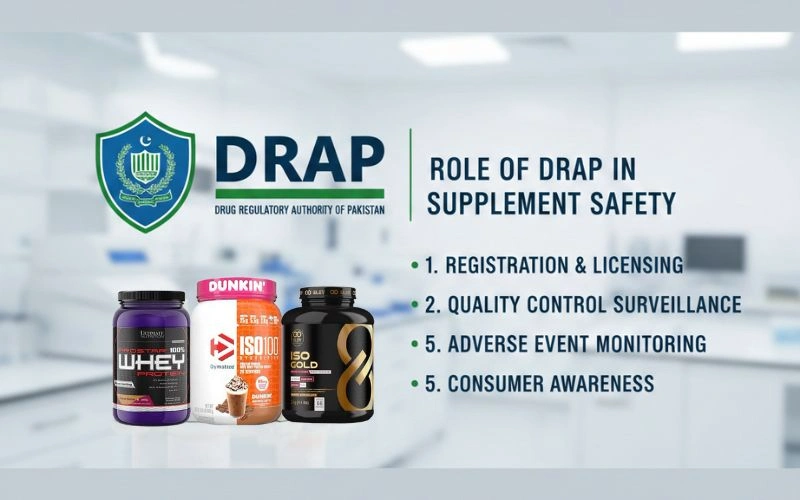
Pakistan’s Drug Regulatory Authority (DRAP) plays a central role in protecting consumers from unsafe supplements, including counterfeit whey protein. Understanding how DRAP functions gives you another layer of confidence in your purchasing decisions.
Regulatory Oversight
DRAP is responsible for setting and enforcing the safety and quality standards that dietary supplements sold in Pakistan must meet. This includes whey protein products imported from abroad. Any product entering the Pakistani market through legitimate channels must comply with DRAP’s requirements, which cover manufacturing standards, ingredient safety, and accurate labeling. You can review the process for checking DRAP-approved supplement listings to cross-check whether a product you are considering has passed official review.
Certification and Testing Standards
Products that carry DRAP certification have been tested to confirm that their protein content, ingredient composition, and safety profile match what is printed on the label. This certification process is designed to be difficult to fake, which is why DRAP-approved products genuinely offer more consumer protection than uncertified alternatives. DRAP certification also reduces the likelihood that a product contains harmful additives or contaminated raw materials, since the certification requires transparent manufacturing documentation.
How to Confirm DRAP Verification on Any Product
The simplest way to verify DRAP compliance is to look for the DRAP registration number printed on the product’s packaging. This number can be cross-referenced on the DRAP official portal. If no registration number is present, the product has either not been approved for the Pakistani market or is a counterfeit of a legitimately approved product. In either case, it represents an unverified purchase and should be avoided.
Where to Verify and Buy Authentic Whey Protein in Pakistan
If you would rather check seals, batch codes, and scoop placement in person before paying, Nutritional World maintains physical branches across the country for exactly this purpose.
- Visit the Lahore branch for verification in person if you are based in central Punjab.
- Check the Islamabad branch stock checks for buyers in the capital region.
- Visit the Faisalabad branch availability for buyers in the surrounding industrial belt.
Every order, whether placed online or in branch, is also backed by clear return and refund protection, so you are never stuck with a product you have doubts about.
Protect Yourself and Your Investment
Buying genuine whey protein in Pakistan requires more attention than it once did, but the verification process is straightforward once you know what to check. Scanning the QR code, confirming importer details, examining packaging quality, checking the scoop placement, and comparing prices across verified retailers will protect you from the vast majority of counterfeit products currently circulating in the market.
Always prioritize authorized sellers who can demonstrate their supply chain credentials. The short-term cost difference between genuine and fake products is far outweighed by the health and performance consequences of choosing the wrong one. For a full range of verified, authentically sourced supplements, explore Nutritional World’s verified supplement range and make your next purchase with complete confidence.
Frequently Asked Questions
How can I check the authenticity of whey protein in Pakistan?
Scan the QR code on the packaging to confirm authenticity through the manufacturer’s database. Also check for the authorized importer’s sticker, verify the DRAP registration number, and ensure all tamper-proof seals are fully intact before opening.
What are the health risks of consuming fake whey protein?
Fake whey protein may contain heavy metals, banned substances, or chemical additives produced in unregulated environments. Regular consumption can cause digestive problems, kidney damage, hormonal imbalances, and nutrient deficiencies due to insufficient or low-quality protein content.
Where can I buy authentic whey protein in Pakistan?
Purchase from authorized retailers with verified supply chains, either online or in licensed physical stores. Trusted platforms like Nutritional World carry DRAP-compliant products with proper importer documentation, tamper-proof packaging, and functioning QR verification codes.
What is DRAP approval and why does it matter for supplements?
DRAP (Drug Regulatory Authority of Pakistan) approval confirms that a supplement has passed safety and quality testing under Pakistan’s official regulatory framework. A product carrying a valid DRAP registration number has been verified for ingredient accuracy, safety, and proper labeling, making it significantly less likely to be counterfeit or harmful.
Is a lower price a reliable sign of fake whey protein?
A significantly lower price compared to the standard market rate is one of the strongest warning signs of a counterfeit product. Genuine imported whey protein carries costs related to quality ingredients, authorized importation, and regulatory compliance. Products priced 30 to 50 percent below the market norm almost always cut these corners in ways that compromise quality and safety.
Can packaging quality alone confirm if whey protein is genuine?
Packaging quality is a useful indicator but should not be used in isolation. Authentic products use sharp printing, tamper-proof seals, and accurate labeling with no spelling errors. However, some high-quality counterfeits can replicate packaging appearance. Always combine the packaging check with QR code verification, importer sticker confirmation, and DRAP number review for reliable authentication.